I hate to drive past any kind of furry friend that has been hit by a vehicle and left alongside the road. It seems like it happens more these days, which we might attribute to the ever-growing population and everything that comes with it.
Do not get me wrong, I love my home, cellphone, and even my car, but I do not like seeing the animals alongside the road. I get the need for housing, stores, and I guess parking lots, but it is costing us more than everyone realizes.
Those of you who know about the Oregon Conservation Strategy know that Oregon has identified 17 amphibians, 58 birds, 29 mammals, 5 reptiles, 60 fish, 62 invertebrates, and 63 plants and algae as target species for restoration. This is important work that our team at Elderberry Wisdom Farm is committed to supporting in the Willamette Valley.
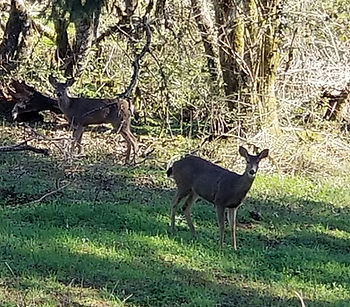
For example, on our four acres here on Delaney Road SE, we have several families of deer that graze on our farm daily. Just the other day I saw a coyote. This was no surprise because we sometimes hear them singing and yapping at night — the most heavenly sound knowing they are some of our original inhabitants.
We also have an owl that I call Grandma Owl who watches over us and sometimes messages us, plus several mountain quail which we first spotted in 2021. They had many babies this summer that scurry around after their mothers near the plant nursery. The list goes on, but you do not get to see these unless you have your own “little slice of heaven.”
I don’t know if my narrative expresses the joy I still feel when I see the deer, the coyote, or any of the animals here on the farm. I grew up in a tiny town in southern Oregon near my tribe, and the land was full of animals I have always enjoyed seeing.
I can’t imagine not being able to see an animal in its natural environment, but instead having to go to a zoo to see a black-tailed deer or a grey squirrel. If we don’t start paying attention to our environment, that may be the only way future generations will see them.
I want to see my grandkids’ eyes light up when they see a wild animal for the first time. That amazement is priceless. So this article is a challenge to all the smart, determined, fearless people on this beautiful Mother Earth to find a way for the proverbial chicken to cross the road.
I know certain developments are necessary for a growing population, but if we can put a man on the moon, why can’t we design safe ways for wildlife to cross roads and highways?
In Alaska, they built wildlife underpasses and fencing so animals can pass safely. In Washington State, squirrel bridges help squirrels cross busy Seattle streets. Here in Oregon, Portland conservationists operate a Frog Shuttle to help the sensitive red-legged frog migrate safely across Highway 30 from Forest Park to nearby wetlands.